
01
Why We Sleep
Walker's landmark neuroscience study presents overwhelming evidence that sleep deprivation is a public health crisis — affecting cognition, immunity, cardiovascular health, and mental wellbeing. Changed how many readers understand everything they sacrifice for productivity.
Find this book →
02
How Emotions Are Made
Barrett's theory of constructed emotion — that feelings are not automatic responses wired into the brain but predictions built from past experience — overturns a century of psychological orthodoxy. Scientifically rigorous and personally transformative.
Find this book →
03
Behave
Sapolsky traces every human behavior back through its biological causes — neurochemistry, hormones, evolution, culture — in a masterpiece of scientific synthesis. His argument that free will is far more constrained than we believe is deeply uncomfortable and deeply convincing.
Find this book →
04
The Happiness Hypothesis
Haidt examines ten great ideas about happiness from ancient philosophy and religious traditions and tests them against modern psychology. The result is a synthesis that honors both ancient wisdom and contemporary science.
Find this book →
05
The Righteous Mind
Haidt's moral psychology explains why good people disagree about politics so vehemently — tracing the divergent moral foundations that conservatives and liberals draw on. The most illuminating book about contemporary political division currently available.
Find this book →
06
Mindsight
Siegel introduces his concept of mindsight — the ability to observe one's own mental processes and those of others — as the key to psychological wellbeing and healthy relationships. Draws on neuroscience, attachment theory, and clinical experience.
Find this book →
07
The Organized Mind
Levitin applies neuroscience to the problem of information overload — explaining why our brains are poorly equipped for the demands of contemporary life and offering practical strategies grounded in cognitive science. Useful and scientifically grounded.
Find this book →
08
Full Catastrophe Living
The foundational text of Mindfulness-Based Stress Reduction — the program Kabat-Zinn developed at the University of Massachusetts that brought meditation into mainstream medicine. Still the most thorough guide to the practice.
Find this book →
09
Mindfulness-Based Cognitive Therapy for Depression
The clinical handbook that describes MBCT, the eight-week program shown in multiple clinical trials to prevent relapse in recurrent depression as effectively as antidepressant medication. A genuine breakthrough in mental health treatment.
Find this book →
10
Anxious
LeDoux distinguishes between anxiety — a conscious feeling — and the defensive survival circuits that actually control threat responses in the brain, arguing that the conflation of these distinct systems has misled both research and treatment. A rigorous scientific corrective.
Find this book →
11
The Emotional Brain
LeDoux's earlier work established that the amygdala is central to fear responses — a finding that transformed both neuroscience and psychology. Essential background for understanding how the brain processes threat and what this means for anxiety disorders.
Find this book →
12
Emotional Intelligence
Goleman popularized the concept of EQ — emotional intelligence — arguing that self-awareness, empathy, and emotional regulation are at least as important as IQ for personal and professional success. One of the most influential popular psychology books ever written.
Find this book →
13
The Influential Mind
Sharot draws on neuroscience to explain why rational argument often fails to change minds — and what actually works. Her findings about emotion, incentives, and social conformity have practical implications for anyone who communicates with others.
Find this book →
14
The Power of Habit
Duhigg explains the neurological loop — cue, routine, reward — that underlies all habitual behavior, and shows how understanding this structure makes habits possible to change. Applied neuroscience at its most practical and readable.
Find this book →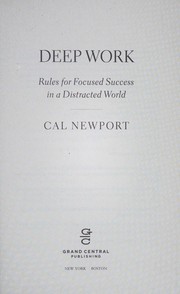
15
Deep Work
Newport argues that the ability to focus without distraction on cognitively demanding tasks is the most valuable skill in the modern economy — and one that most workers systematically undervalue and underprotect. His prescription is deliberate, structured solitude.
Find this book →
16
The Shallows
Carr draws on neuroscience to argue that internet use is physically reshaping the brain — promoting shallow, distracted processing at the expense of the deep reading and sustained attention that built literate culture. A warning that remains urgently relevant.
Find this book →
17
Mindfulness in Plain English
The most straightforward and unpretentious guide to Vipassana meditation in English — written by a Sri Lankan monk who strips away the cultural and mystical packaging to present the practice in purely practical terms. The ideal book for beginning meditation.
Find this book →
18
The Molecule of More
Lieberman and Long argue that dopamine — the neurotransmitter of anticipation and craving — is the key to understanding addiction, creativity, politics, and romantic love. A single neurochemical explains more human behavior than seems possible.
Find this book →
19
Humankind
Bregman's counterintuitive argument that humans are fundamentally good — not nasty, brutish, and short as Hobbes claimed — marshals historical and scientific evidence to challenge pessimism about human nature. Hopeful without being naive.
Find this book →
20
The Neuroscience of Mindfulness Meditation
A leading neuroscientist reviews the research evidence for how mindfulness meditation changes the brain — examining structural changes, improved attention, reduced amygdala reactivity, and enhanced immune function. The scientific case for contemplative practice.
Find this book →